
 Login
Login 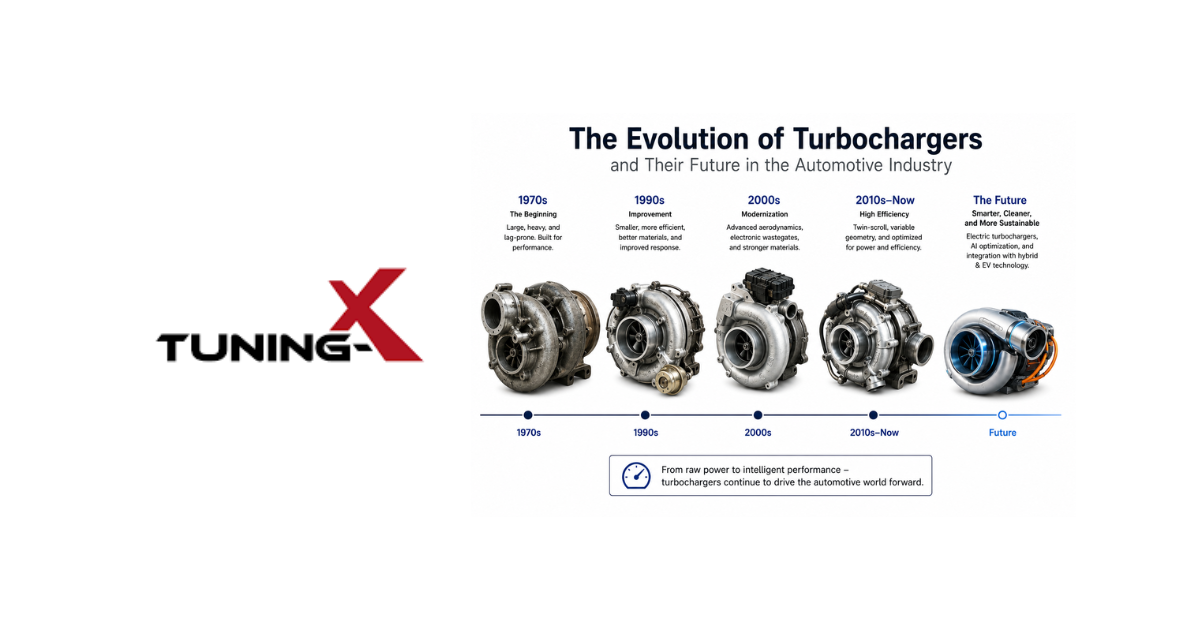

The Evolution of Turbochargers and Their Future in the Automotive Industry.
For many decades, turbochargers have improved the performance of many engines and played a major role in shaping the car industry. Although at the beginning it was considered a technology that was reserved and mainly used for racing cars and high-performance machines, turbocharging has evolved into one of the most widely used engineering solutions in modern vehicles. In the last decade, turbocharged engines have been found in almost any vehicle, from compact city cars to luxury sedans, heavy-duty trucks, and hybrid performance vehicles.
The evolution of turbocharging goes alongside the general evolution of the automotive industry. What began as an experimental method to increase engine power eventually became a key technology for improving fuel efficiency and greatly reducing emissions. In the last decade, governments around the world introduced stricter environmental regulations, and consumers demanded better performance with lower fuel consumption. Turbochargers helped smaller engines to produce way more power.
Now, with the electrification of vehicles, turbocharging is entering another phase of development. Instead of disappearing and becoming obsolete, the turbos are adapting to hybrid systems, electric assistance, and alternative fuels. Ensuring it remains relevant in the future of mobility and continues to help upgrade engine performance.
The Origins of Turbocharging.
Turbocharging first appeared back in the early 20th century. In 1905, a Swiss engineer named Alfred Büchi patented one of the first concepts for a turbocharger. His idea was simple and revolutionary: use exhaust gases that would normally be wasted to drive a turbine capable of forcing more air into an engine.
Initially, turbocharging was not designed for passenger vehicles. The turbocharging technology was first majorly used in aviation. Aircraft engines operating at high altitudes faced performance issues because thinner air reduced their performance. Turbochargers solve this problem by compressing incoming air. This way, engines could maintain power even at higher altitudes.
During the mid-20th century, turbocharging made its entrance in diesel trucks, ships, and industrial engines. Diesel engines benefited from turbocharging because they could generate significantly more torque without compromising efficiency. During the 1960s, manufacturers introduced some of the first turbocharged production cars. Models like the Chevrolet Corvair Monza Turbo and the Oldsmobile Jetfire. Although these early turbo systems were innovative, they also revealed many challenges. Turbo lag, inconsistent reliability, and complicated maintenance prevented widespread adoption.
Although this technology faced many issues at its appearance, it kept evolving. By the 1970s and 1980s, turbocharging became strongly associated with motorsports and high-performance driving. Formula 1 teams helped a lot with turbo engine refinement. Porsche, with the iconic 911 Turbo, showed to the whole world the power potential of forced induction.
Many brands also helped to make popular turbocharged vehicles among ordinary drivers by marketing turbocharged vehicles as practical and efficient rather than purely performance-focused.
How Turbochargers Work.
In a turbocharger system, exhaust gases are used to spin a turbine connected to a compressor. The compressor pushes additional air into the engine’s combustion chamber. This way, way more fuel is able to be burned. The result is that the engine produces greater power without increasing its physical size.
In simple terms, a turbo makes an engine burn fuel more efficiently and produce way more power. As everyone knows, in naturally aspirated engines, atmospheric pressure draws air into the cylinders. Turbochargers main benefit is that smaller engines can generate output similar to much larger engines.
Modern turbo systems include advanced components, like intercoolers, which reduce the temperature of compressed air entering the engine to further improve efficiency and reliability. Engineers have also developed several variations of turbocharger technology to maximize benefits and reduce drawbacks.
The last few years have seen many variations like twin-scroll turbochargers, which separate exhaust flows to improve airflow and throttle response. Variable geometry turbos use adjustable vanes to optimize performance at different engine speeds according to the needs. And sequential turbo systems that use multiple turbos that are working at different RPM ranges to balance low-end responsiveness with high-end power.
Finally, anti-lag systems were developed to maintain turbo pressure even when rpms are at the low end.
The Rise of Turbocharging in Modern Cars.
During the late 1990s and early 2000s, turbocharging use exploded. Governments around the world introduced strict fuel economy and emissions regulations, forcing automakers to turn to smaller engines with better emissions.
Many manufacturers realized they could easily replace the larger naturally aspirated engines that were used for many years with smaller turbocharged ones, keeping the same or even better performance levels. This strategy became known as engine downsizing.
New compact turbocharged four-cylinder engines capable of producing impressive power with lower fuel consumption replaced the large six-cylinder or eight-cylinder engines. The combination of direct fuel injection, improved electronics, and better turbo materials made these engines more practical and reliable, and they were introduced in daily-driven family cars.
Ford’s EcoBoost engines became one of the most recognizable examples of downsizing. Volkswagen expanded its TSI turbocharged series, while BMW and Mercedes-Benz integrated turbocharging across much of their performance and luxury ranges.
Turbocharged diesel engines also became the first choice in many European markets because of their efficiency and strong torque delivery. For years, diesel turbos represented the ideal balance between economy and drivability for long-distance travel.
Formula 1 played a major role in advancing turbo technology and making it useful for the decades to come. The sport’s hybrid turbo engines made clear how turbo engines could work alongside electrification to achieve extraordinary levels of efficiency and performance.
Modern turbocharged vehicles are really different from the first models. Improved software electronic engine management systems have greatly reduced turbo lag and enhanced drivability. Today’s turbocharged engines feel smooth and responsive and are great for everyday use.
More importantly, turbocharging evolved from a performance-focused feature into an efficiency-focused necessity.
Challenges and Criticism.
Although turbocharging is a successful system that has helped internal combustion engine development, it is not without criticism.
One of the most common drawbacks is turbo lag. The distinguished delay between pressing the accelerator and receiving full boost pressure. While modern technologies have minimized this problem, and in many cases it is almost unnoticeable, some drivers still prefer the immediate throttle response of naturally aspirated engines.
Turbocharged engines are also mechanically way more complex than conventional engines. Additional components, higher operating temperatures, and increased pressure stress engine systems way more, and if maintenance is not at high levels, it can lead to failures. Particularly, oil changes and overheating monitoring must always be kept in mind.
Carbon buildup over time has been a concern for direct-injection turbo engines. In some cases, real-world fuel economy has failed to match official laboratory figures, especially when drivers frequently use turbo boost aggressively, which is a reality for most modern drivers.
Sometimes, smaller turbocharged engines lack the sound and character of larger naturally aspirated engines.
However, ongoing engineering improvements continue to solve many of these concerns. Modern turbo systems are way more reliable, efficient, and refined than earlier generations.
The Future of Turbocharging.
The last years, manufacturers have been moving toward electrification, and many people think that turbocharging will eventually disappear. In reality, the technology is likely to evolve rather than vanish.
Hybrid systems represent one of the most important opportunities for future turbocharger development. Electrically assisted turbochargers are already appearing in high-performance and luxury vehicles. These systems use electric motors to spin the turbo before exhaust gases build sufficient pressure, nearly eliminating turbo lag.
Manufacturers are combining turbocharged engines with mild-hybrid systems and 48-volt electrical systems in newer vehicles. This approach improves efficiency while maintaining performance.
Turbocharging may also be used in alternative-fuel engines. Engines using hydrogen combustion technology. Since they still rely on air intake and combustion processes, turbochargers will play a major role in improving efficiency and power.
Heavy vehicles are another area where turbocharging is unlikely to disappear anytime soon. Heavy-duty trucks, industrial equipment, and long-haul transport systems, alongside farm tractors, still depend heavily on turbo diesel technology because of its torque and efficiency advantages.
The transition to fully electric transportation will take time. Assuming that electric vehicles will one day replace the traditional ones. During this period, turbocharging is expected to remain a key technology that helps combustion engines become cleaner, smaller, and more efficient.
Conclusion.
Turbocharging has developed for more than a century since its first appearance. Originally used in aviation, the technology gradually expanded into other applications before becoming a key feature of modern passenger vehicles. All these years, turbocharging has evolved in response to changing engineering demands, and it is likely to remain an important part of vehicle design in the years to come.