
 Login
Login 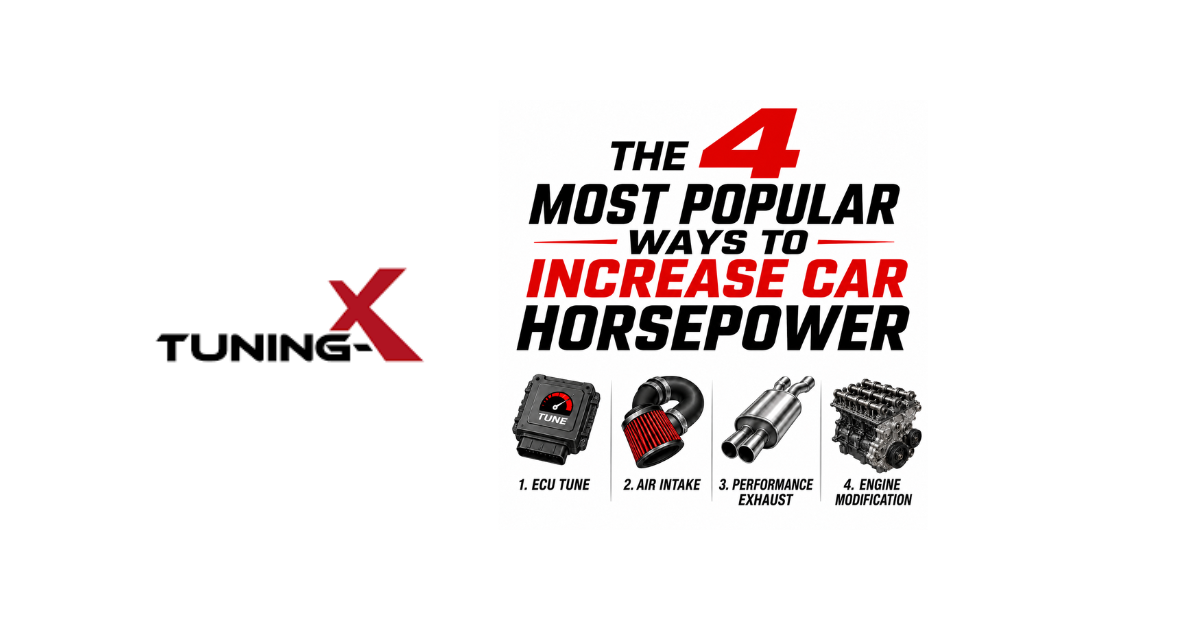

The 4 Most Popular Ways to Increase a Car’s Horsepower.
For many car owners and tuners, horsepower is more than just a number on a dyno sheet. It represents performance, acceleration, the overall driving experience, and the pleasure that is derived from it. Whether the goal is quicker acceleration, improved responsiveness, or simply a more fun and spirited ride, finding a way to increase a car’s horsepower remains one of the most common objectives among car owners and tuners.
Modern vehicles are designed with a balance of performance, fuel economy, reliability, and emissions compliance. This means that many engines have, from the factory, hidden potential that can be unlocked through carefully selected modifications. While there are many types of performance upgrades available on the market, some of these methods have proven to be particularly popular due to their effectiveness and accessibility.
The following are the four most popular ways to increase car horsepower, ranging from simple upgrades to more advanced modifications. Let’s find out about them.
ECU Upgrade and Engine Tuning.
Among all performance upgrades in modern vehicles, ECU tuning is considered one of the most effective and interactive methods for increasing horsepower.
The Engine Control Unit (ECU) is considered to be the brain of the vehicle. It controls engine functions such as fuel delivery, ignition timing, and turbo pressure all the time. Manufacturers typically program the ECU to back off engines’ true potential. This happens to meet global regulations and emissions standards.
An ECU upgrade, also known as engine tuning or remapping, involves the alteration of the ECU’s software parameters. By changing these settings, the engine can produce more power than stock without the need for any mechanical changes.
The benefits of ECU tuning vary depending on the engine type. Typically, a naturally aspirated engine sees gains of 5% to 15%, and a turbocharged engine at the same time can see larger improvements. It can gain 20% to 35% horsepower, or even more.
Drivers often can see several improvements after a professional ECU tune, including:
- Increased horsepower and torque.
- Faster throttle response.
- Improved acceleration.
- Better power delivery throughout the rev range.
That said, ECU tuning should always be performed by reputable, experienced professionals using reliable software. Poorly or badly executed tuning can lead to reduced reliability, increased fuel consumption, or even engine damage.
Because of its excellent performance-to-cost ratio, ECU tuning remains one of the most popular horsepower-enhancing modifications available today.
Installing a High-Performance Air Filter.
One of the easiest and most affordable ways to improve engine performance and gain hp in an internal combustion engine is by installing a high-performance, aftermarket air filter. It is known that an internal combustion engine requires three essential elements to produce power: air, fuel, and spark. Increasing the amount of clean air entering the engine can greatly help improve combustion efficiency and, on many occasions, lead to a modest horsepower gain.
Factory air filters are often designed with a strong emphasis on filtration and longevity rather than maximum airflow. While they do exactly what they are designed to do, to protect the engine from dirt and debris, they can also create a restriction in the air intake system.
More aftermarket performance air filters are designed to reduce airflow restrictions and allow the engine to breathe more freely. These filters are typically made from foam or synthetic materials that promote higher airflow while still filtering in a good level of the incoming air. The horsepower gains from a performance air filter alone are usually modest, often ranging from 1 to 5 horsepower depending on the vehicle and the setup. However, when this upgrade is combined with other performance modifications, the improved airflow can produce noticeable results.
Another advantage is how simple it is to install it. In almost every vehicle, replacing the stock air filter can be completed in just a few minutes without the need for special tools. For drivers who seek an inexpensive introduction to vehicle performance upgrades, this modification is often the first step.
Exhaust System Modification.
In order for an internal combustion engine to work efficiently, it should inhale and exhale freely. While modifications in the intake system help air enter the engine, upgrades on the exhaust system help combustion gases exit more freely, reducing back pressure.
Most of the time, factory exhaust systems are built with noise reduction and emissions compliance as their top priorities. This can limit exhaust flow and create backpressure, reducing this way engine performance.
Upgrading the exhaust system can improve the engine’s ability to expel spent gases and allow fresh air and fuel to enter the combustion chambers easily. Increasing horsepower and improving engine efficiency easily.
Let’s see some of the most important exhaust components that can be upgraded:
Cat-Back Exhaust Systems.
A cat-back exhaust replaces the components located after the catalytic converter. These systems typically improve exhaust flow while improving engine sound.
Performance Headers.
A performance header replaces the factory exhaust manifold. By improving gas flow, headers can help an engine to generate more horsepower.
High-Flow Catalytic Converters.
A high-flow catalytic converter maintains emissions compliance, like the factory one, while allowing exhaust gases to move more freely.
The exact power that an engine can gain depends on the vehicle and the specific modifications that take place. Some cars may gain a few horsepower, while others can gain way more, especially when exhaust upgrades are combined with ECU tuning and intake improvements.
Engine Modification.
For everyone who seeks absolute horsepower increases, engine modifications are the best way to achieve it. Unlike simple upgrades that boost an engine using the existing parts, engine modifications alter the engine’s internal components to generate more power. These upgrades range from changing a few parts to complete engine rebuilds. Let’s see the most common engine modifications and see their impact.
Performance Camshafts.
Performance camshafts alter valve timing and lift characteristics, allowing the engine to use more air and fuel at higher engine speeds. This increases horsepower in the upper RPM range.
Upgraded Pistons and Connecting Rods.
Internal components from stronger, more durable materials allow the engine to safely withstand higher power and much increased cylinder pressures.
Turbocharger Installation.
Adding a turbocharger is one of the most effective ways to increase horsepower. Turbochargers compress incoming air, allowing the engine to burn more fuel and produce more power.
Supercharger Installation.
Like turbochargers, superchargers force air into the engine. They are mechanically driven by the engine itself. Superchargers often provide immediate power delivery and strong low-end torque.
Engine modifications can transform a vehicle’s performance capabilities, but they also require much more expense. In addition, supporting upgrades such as enhanced cooling systems, stronger transmissions, and upgraded fuel systems may be necessary to maintain reliability.
For everyone who seeks maximum horsepower gains, engine modification remains the ultimate path to increased performance.
Conclusion
Increasing horsepower is one of the most common goals for most car owners, and there are several proven ways to get great results. A high-performance air filter is often an easy and affordable starting point, while an ECU tune can unlock significant power gains for a small cost. Upgrading the exhaust system can help the engine breathe more efficiently, and more extensive engine modifications offer the greatest potential for huge increases in power.
In many cases, the best results come from combining upgrades that work well together. For example, pairing a performance air filter with an ECU tune and a freer-flowing exhaust can deliver a noticeable improvement in power. For drivers looking for even greater performance, additional engine modifications can take things further. Understanding the benefits of each option makes it easier to choose upgrades that fit both the goals and the available budget.