
 Login
Login 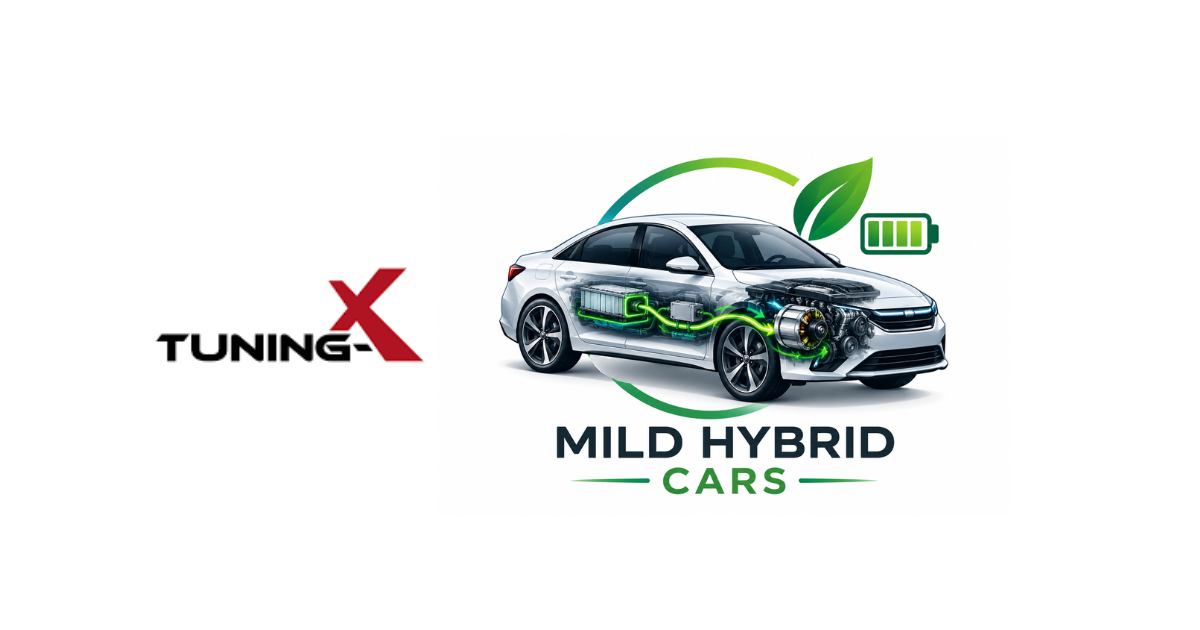

Mild hybrid cars.
Understanding how they work.
Latest decades, as the automotive industry aims for cleaner and more efficient forms of vehicles, hybrid technology has become common, and is met more and more. While many people know what a traditional hybrid car is, and that it can drive using electric power alone. There is another type of hybrid system that takes a simpler approach: the mild hybrid.
Mild hybrid cars have become popular because they can improve fuel efficiency and reduce emissions without requiring the complex and expensive technology associated with a full hybrid vehicle. For drivers, can aplause many of the benefits of an electric car while retaining the familiar driving experience of a conventional internal combustion petrol or diesel car.
But how exactly does a mild hybrid system work, and what makes it different from other types of hybrid vehicles? Lets find out.
What Is a Mild Hybrid Car?
A mild hybrid car is a vehicle that combines a conventional petrol or diesel internal combustion engine with a small electric motor and battery. A mild hybrid generally cannot use its electric motor to drive the car independently for a long distance or under heavy load.
In mild hybrid systems, the electric motor supports the internal combustion engine. When the vehicle accelerates, it engages and provides additional power. It recovers energy when the car slows down, during braking. This allows the engine to switch off during certain situations and driving conditions.
The main purpose of this technology is not to replace the internal combustion engine but to make it work way more efficiently.
Most mild hybrid systems use a small battery compared with the ones used in plug-in or full hybrid vehicles. Depending on the vehicle make, model, and size, the electrical system may operate at 12, 24, or 48 volts, with 48-volt systems becoming particularly common in modern cars.
The Main Components
Mild Hybrid cars have several important components that are cooperating. Let’s see the most important ones.
- The first and most important component is the internal combustion engine. It is the primary engine that moves the vehicle. It can either be a petrol or diesel engine.
- The second major component is the electric motor. The electric motor helps the internal combustion engine when the vehicle is accelerating or simply driving, and it also produces electricity when the vehicle slows down during braking.
- The third component is the small battery pack. This battery stores the electricity recovered during driving. Because the battery is relatively compact, it does not take up much space, and it does not add much weight to the vehicle.
- The last part is an electronic control system. This unit controls all the above components. It coordinates the engine, the electric motor, and the battery. It monitors all the important factors like the vehicle speed, the acceleration, the braking, and the battery charge to ensure they operate as designed.
How Mild Hybrid Technology Works?
One of the most important features that makes this system efficient is the regenerative braking. In an everyday conventional car, the energy created when a vehicle slows down is almost completely lost in the form of heat through the brakes. On a mild hybrid system, some of this energy is recovered in the form of electric power.
When the vehicle retards, eithe whenb driver lifts off the accelerator pedal or applies the brakes, the electric motor operates as a generator. The generator produces electricity, which is then sent to the battery. This process has a name it is called regenerative braking. The stored electricity can be used to support the engine.
This assistance reduces the use of the combustion engine. As a result, the engine consumes less fuel than it would if it had to move the vehicle on its own.
Engine Start and Stop.
Another important feature of the mild hybrid vehicles is the improvemnt of start and stop system function. As everyone knows in an ordinary start-stop vehicle, the engine may switch off when the car comes to a stop, such as at a traffic light. It then starts when the driver releases the brake or presses the accelerator, this is happening to safe fuel and reduce polution.
Repeatedly starting a conventional engine can create noise, vibration and wear, particularly in heavy traffic. A mild hybrid system can use its electric motor-generator to restart the engine quicker and smoothly.
The engine may also be switched off earlier when the vehicle is approaching a stop. In some systems, the engine can shut down while the vehicle is still moving toward a traffic light, if the conditions are suitable.
This allows the car to avoid using fuel during periods when the engine is not working.
Electric Assistance During Acceleration.
During acceleration, an internal combustion engine requires more fuel to achieve the goal quickly. A mild hybrid system helps a lot during acceleration of the vehicle. When the driver presses the accelerator, the electric motor engages, providing extra power and helping this way the engine. This is known as electric boost.
The effect is usually soft. A mild hybrid car does not perform like an electric vehicle when accelerating. But the electric power can make acceleration faster and can help the engine operate more efficiently. In some vehicles, the electric motor can also work at low speeds, almost minimizing the internal engine function. This can contribute to improved fuel consumption.
Mild Hybrid vs Full Hybrid.
There are important and noticeable differences between mild hybrid and full hybrid vehicles. A full hybrid has a larger battery, and its electric motor is way more powerful. It can often drive on electric power alone for short distances, especially at low speeds. The combustion engine can therefore remain switched off under certain conditions.
A mild hybrid in most cases does not have enough electric power to do this. Its electric motor primarily assists the combustion engine in specific conditions and does not replace it.
This difference makes mild hybrid systems simpler and, in many cases, less expensive to manufacture. A mild hybrid vehicle in most cases does not need to be plugged into an external power source. Its battery is charged automatically through regenerative braking and, depending on the system, energy generated by the engine.
Advantages of Mild Hybrid Cars.
The biggest advantage of mild Hybrid technology is it is efficient. The system recovers energy during braking to allow the vehicle to reduce fuel consumption. Mild hybrids can also help cut emissions. Another advantage of mild hybrids is that it is easy for a manufacturer to convert any existing design of a normal vehicle with an internal combustion engine. Drivers won’t have to learn new charging routines or make drastic changes to their driving habits.
By design, mild hybrids use relatively small batteries, avoiding some of the weight and packaging challenges that larger full hybrid models face.
Do mild hybrids have any Disadvantages?
Like everyting Mild hybrid technology is not without disadvantages. The most obvious one is that a mild hybrid cannot normally provide electric-only driving, or if it can provide it is for short distances. Drivers looking for a vehicle capable of travelling several kilometres without using the combustion engine would need to consider a full hybrid, plug-in hybrid or fully electric vehicle instead.
They are also more complex when compared with a conventional petrol or diesel car. The motor-generator, battery and associated electronics add components that may require maintenance or eventual replacement. Furthermore, the fuel savings offered by mild hybrid technology can vary considerably. A driver who spends most of the time travelling at steady motorway speeds may see less benefit than someone who regularly drives and has a lot of starts and stops.
The Future of Mild Hybrid Technology.
Mild hybrid systems represent one of the ways car manufacturers increasing electrification across their vehicle ranges. Although they do not provide the same level of electric driving capability as full hybrids or electric vehicles, they can improve efficiency without altering the traditional driving experience.
In addition, as emissions regulations become stricter and manufacturers continue to search for ways to reduce fuel consumption, mild hybrid technology is likely to be used in the future.
For drivers, a mild hybrid car retains the convenience and familiarity of a conventional combustion engine while using electricity to recover energy, assist acceleration and reduce unnecessary engine operation.
Ultimately, a mild hybrid is best understood not as an electric car with a petrol engine, but as a conventional car that has been given an electrical helping hand. That combination of familiar driving and improved efficiency explains why mild hybrid cars have become an important stepping stone between traditional vehicles and the increasingly electrified future of vehicles.